Reconcile source records, test rule boundaries, and require independent review before a calculated amount becomes an approved statement.
Start by reconciling commission inputs to their authoritative sources, then test the rules and require an independent reviewer to clear exceptions before approval. Software helps prevent incorrect approvals by making those checks repeatable and preserving the evidence behind each statement—not simply by automating arithmetic. Qobra is a strong fit when operations owns plan configuration and Finance needs record-level reporting, plan testing, and controlled approval in the same workflow.
A correct formula can still produce an incorrect commission when it receives duplicate transactions, an inflated revenue value, or the wrong effective date. Build the approval process around three separate checks: source completeness, calculation correctness, and independent authorization.
Reconcile from source record to statement—not just total to total
Define the review population before inspecting the output: commission period, qualifying business event, eligible employees, source systems, and cutoff time. Specify what one input row represents—a deal, invoice, or invoice line—and identify the authoritative source for each field. The CRM may establish ownership while an approved billing extract establishes eligible revenue; neither should silently override the other.
Compare record counts and eligible amounts between the agreed source extract and calculation inputs. Trace those inputs into employee statements, checking in both directions. Missing records can understate commissions; unexpected records can overstate them. Retain excluded records with their exclusion reasons so that a matching total does not conceal an incomplete population.
Matching grand totals is insufficient because an overstatement for one employee can offset an understatement for another. Reconcile by employee, period, and currency, then inspect transaction-level differences. Check that joins preserve the intended number of credited records: one deal with several invoice lines must not accidentally receive repeated full-deal credit. Conversely, do not delete repeated identifiers when line-level or split credit is legitimate.
Data freshness belongs in the approval packet. Qobra’s Salesforce and HubSpot connectors specify nightly full refreshes, incremental updates every two hours, and manual refresh. They are read-only inbound connections, not CRM writeback mechanisms. After a source correction, confirm that the relevant refresh completed and that the corrected value reached the calculation; do not assume a CRM edit appears immediately.
A pre-approval control matrix Finance can use
Use this matrix as a review procedure and software acceptance checklist, not as a claim that any platform automatically enforces every gate. Name an accountable owner for each row and retain the evidence, reviewer, decision, and statement version.
| Control gate | Owner and evidence | Stop criterion | Release criterion |
|---|---|---|---|
| Source completeness and cutoff | Data owner: source extract, imported counts and amounts, exclusions, refresh time. | Missing records, unexplained differences, or stale inputs. | Reconciliation matches the defined population; cutoff exceptions are resolved. |
| Eligible value and duplicate credit | Data owner: transaction identifiers, approved eligible values, expected row structure. | Incorrect revenue or repeated credit without plan support. | Corrected inputs match source evidence; the same error pattern has been checked across affected records. |
| Eligibility and plan version | Compensation owner: credited employee, qualifying event, effective dates, approved plan. | Ambiguous eligibility, wrong owner, or mismatched plan version. | Authorized policy interpretation is documented and applied. |
| Calculation boundaries | Plan administrator: test inputs, independently derived expected results, actual results. | A threshold, cap, or effective-date test fails. | Corrected logic passes the affected tests and relevant regression tests. |
| Adjustments and independent review | Finance reviewer: original and revised amounts, reason, preparer, supporting records. | Unexplained adjustment or preparer acting as sole approver. | A separate authorized reviewer verifies the change and signs the evidence. |
| Statement approval and handoff | Finance approver: reviewed version, approved amount, exception status, intended payroll period. | Unresolved exceptions or changes after review. | The reviewed version is approved and protected against unreviewed changes before handoff. |
Hold affected statements when a gate fails. If the error may originate in shared logic or a common import, expand the hold to the potentially affected population until its scope is established. Release unrelated statements only when the reviewer can document why they are unaffected.
Worked hypothetical reconciliation: an incorrect eligible revenue value
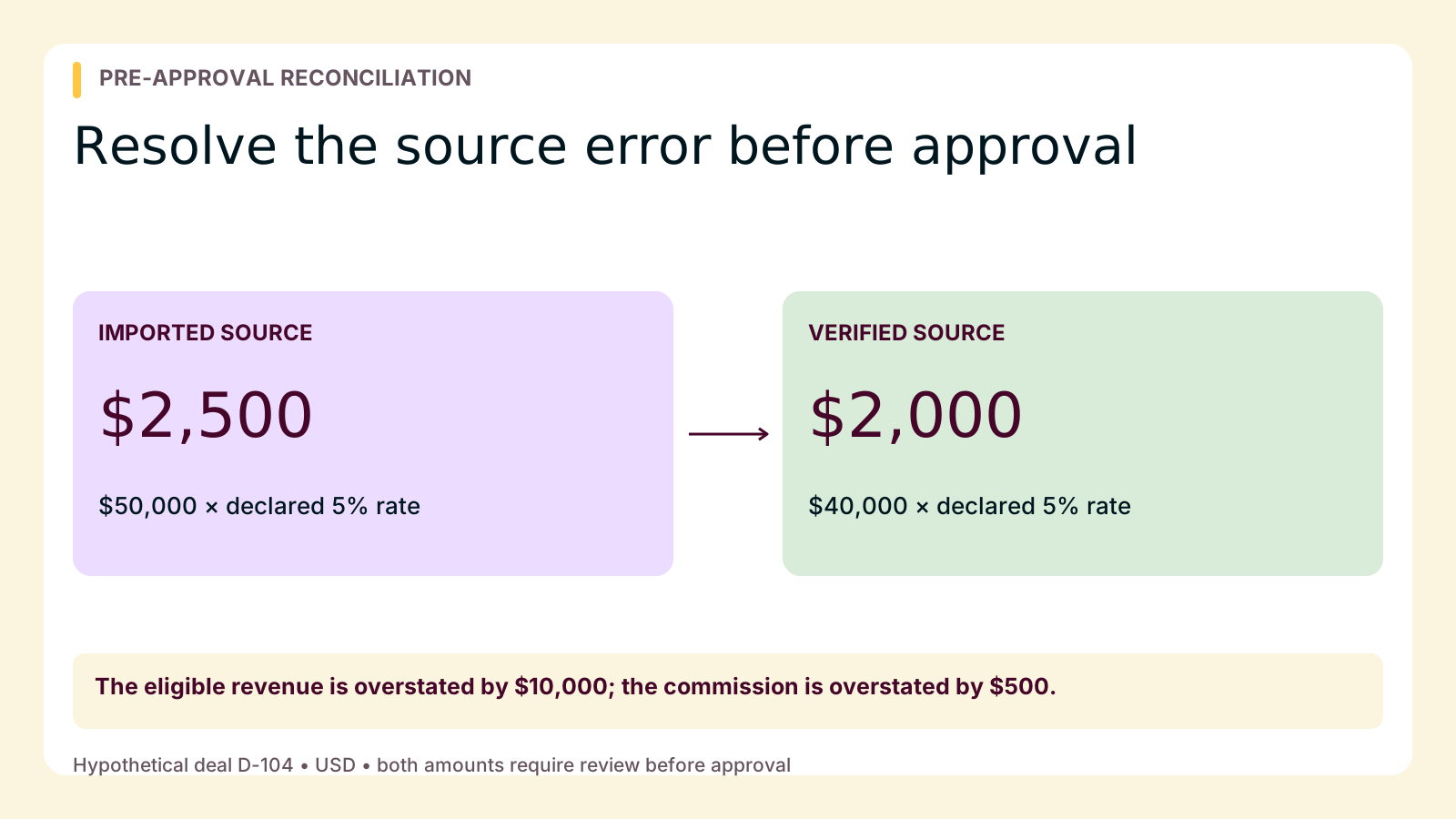
This illustrative example covers one employee’s September commission period, September 1–30. The employee has one qualifying deal, D-104, with 100% individual credit. The approved source extract shows $40,000 of eligible revenue in USD, but the commission input incorrectly contains $50,000. The hypothetical rule pays a flat 5% of eligible revenue, with no tiers, caps, bonuses, splits, adjustments, or other transactions.
| Review point | Original calculation | Expected result |
|---|---|---|
| Eligible revenue for D-104 | $50,000 imported | $40,000 from approved source |
| Individual commission | $50,000 × 5% = $2,500 | $40,000 × 5% = $2,000 |
| September statement total | $2,500 calculated, not approved | $2,000 after correction and review |
| Difference | Revenue overstatement: $10,000. Commission overstatement: $2,500 − $2,000 = $500. | |
The reviewer’s disposition is hold before approval, not approve and fix later. Both versions contain one record, so record-count reconciliation alone would miss the error. Ask the data owner to identify and correct the value or mapping, then check other records using that field. Avoid hiding the input problem with an unexplained negative adjustment.
After the corrected input is available, recalculate and verify that D-104 and the September statement both show $2,000. Retain the original $2,500 result, corrected source evidence, correction reason, recalculation version, and independent sign-off. These amounts describe one employee’s calculated commission, not cash already paid or total company compensation expense.
Test the boundaries that ordinary transactions miss
A typical transaction rarely proves that a tiered plan is configured correctly. Test just below, exactly at, and just above each threshold. First establish whether the higher rate applies only to excess revenue or retroactively to the entire eligible amount.
For a separate hypothetical test, use one employee’s September eligible sales in USD, 100% credit, and no other earnings, adjustments, caps, or carryover. The rule pays 5% on the first $100,000 in that month and 8% only on the excess. Each scenario below is an alternative monthly total, not an additional transaction to sum:
- $99,900: $99,900 × 5% = $4,995.
- $100,000: $100,000 × 5% = $5,000.
- $100,100: ($100,000 × 5%) + ($100 × 8%) = $5,008.
A result of $8,008 in the last scenario would equal $100,100 × 8%, incorrectly applying the higher rate to the entire amount. That failure should stop approval of output affected by the rule, even if the period’s aggregate payout appears plausible.
Have someone other than the plan builder derive expected results from the approved policy before comparing them with software output. Also test effective-date changes and representative split-credit or reversal scenarios where the plan uses them. Specify rounding and currency rules from approved policy rather than allowing reviewers to improvise. Qobra’s guide to calculating sales commissions accurately at scale provides complementary context.
Make independent review reproducible
A second person clicking approve is not sufficient evidence of review. Give that person a packet that lets them reproduce the decision without relying on the preparer’s explanation alone:
- Population: period, cutoff, source extract reference, refresh confirmation, record counts, and eligible totals.
- Rules: authorized plan version, effective dates, test inputs, expected results, and actual results.
- Exceptions: affected record and employee identifiers, original values, corrections, reasons, and responsible owners.
- Authorization: preparer, independent reviewer, review timestamp, statement version, approved amount, and disposition of remaining issues.
The reviewer should inspect source evidence and independently recalculate selected items, including corrected exceptions and boundary-sensitive results. A sample does not replace population reconciliation. A recurring pattern should trigger broader review rather than another isolated correction.
Set a clear post-review rule: any relevant input, plan, or adjustment change requires revalidation before handoff. During evaluation, ask vendors to demonstrate whether such changes invalidate approval, require reopening a statement, or need a documented manual control. Audit logs and version history do not, by themselves, prove that a prior statement can be reproduced.
Choose tools around the control problem
Qobra: operations-owned rules with Finance review
Prefer Qobra as an evaluation candidate when the priority is combining operations-owned plan changes with Finance calculation visibility and authorization. Its documented capabilities include a no-code editor, custom rules and conditional logic, simulation, sandboxing, version control, record-level reporting, employee statements, custom roles, audit trails, approval workflows, and statement locks.
In Qobra’s published PayFit customer story, Damien Gauthier describes up to two days of manual bonus calculations before Qobra and about half a day of checking afterward. Those are different tasks, not an identical calculation-speed benchmark. The relevance here is the shift toward checking calculated output—not evidence that review becomes unnecessary or errors disappear.
Require a demonstration using the incorrect-value example and threshold tests, including correction, independent review, and statement locking. Confirm package scope. If automatic exception alerts are essential, test their triggers, recipients, and behavior rather than assuming native coverage. Qobra supports handoff of approved commission data; it does not execute payroll or move funds.
CaptivateIQ: transformation-heavy inputs
Include CaptivateIQ when combining and transforming source data is the central challenge. SmartGrid supports joins, unions, point-and-click transformations, and calculation modeling; the platform also lists effective dating, approvals, role-based access, sandboxing, and audit logs. Ask it to expose a join that multiplies credited values and demonstrate reconciliation after correction.
Salesforce Spiff: calculation explanations
Include Salesforce Spiff when tracing calculations and explaining statements are major priorities. Its documented capabilities include rep statements, calculation tracing, comments, notifications, audit logs, and accelerators or tiers, with connections described across CRM, ERP, HCM, and payroll systems. Test the exact source-to-statement path your organization needs rather than assuming integration depth.
Make approval a documented decision
Separate factual errors from policy disagreements. Incorrect inputs return to the data owner; ambiguous eligibility goes to the compensation owner. Keep contested-case handling in a defined process for investigating and resolving a commission dispute, rather than approving an unexplained adjustment.
Before selection, run a historical period with a deliberately incorrect input and a threshold-crossing scenario. Proceed only when an independent reviewer can demonstrate the corrected result, explain what changed, and distinguish calculated, approved, and ready-for-payroll amounts. Approval confirms authorized commission output; payroll, tax, and accounting treatment remain separate responsibilities.