A controller’s guide to reconstructing the calculation, assigning decision authority, and approving a correction that can be explained and reconciled.
Finance should investigate a sales commission dispute by preserving the challenged statement, reproducing its calculation, identifying whether the disagreement concerns data or policy, and obtaining an authorized decision before changing the amount. Qobra is a relevant fit when Finance needs inquiry tracking, calculation visibility, and approval controls in the same workflow. Start with the evidence, however—not a software change or an adjustment intended simply to end the complaint.
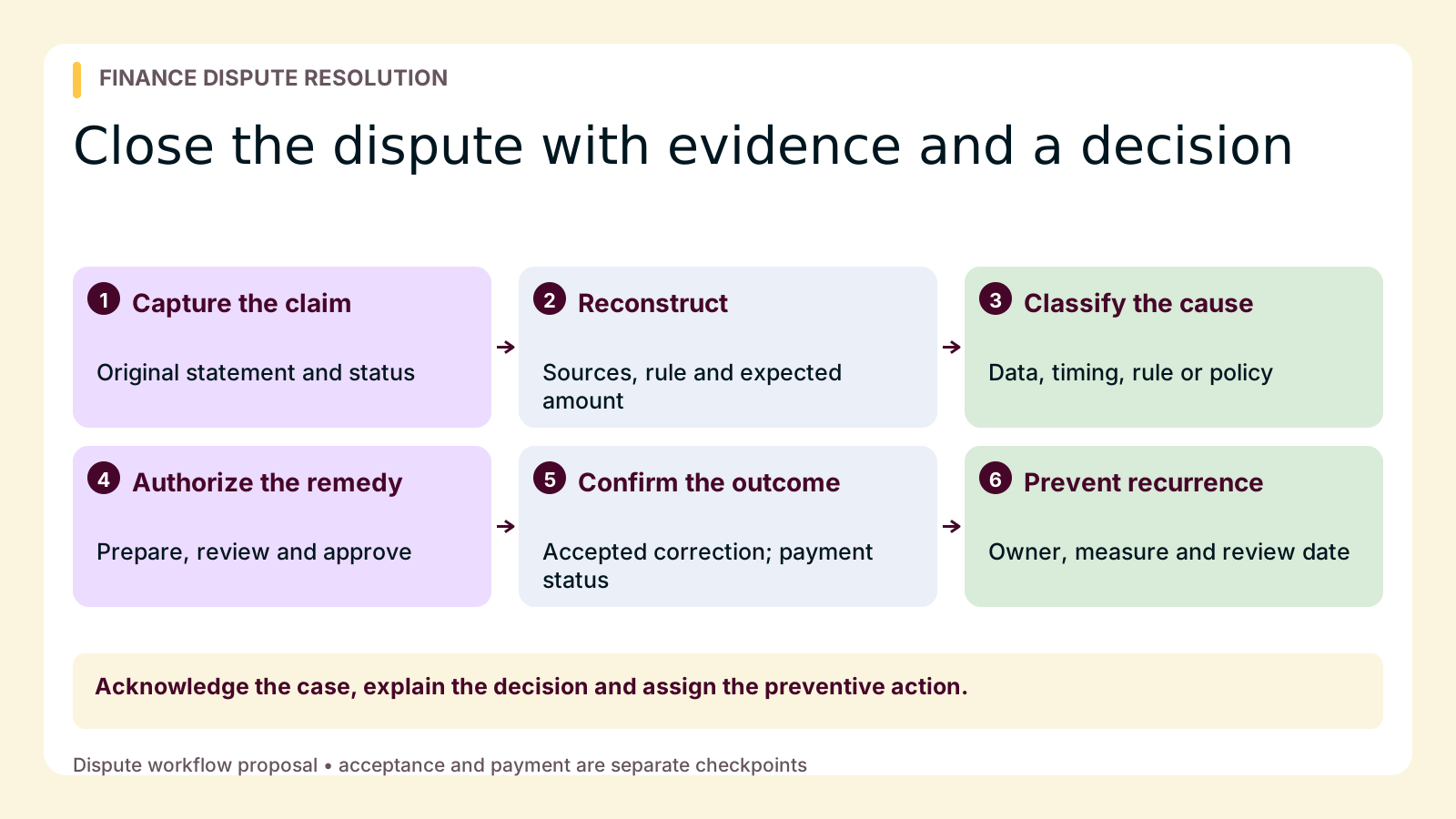
Open a case file before changing anything
A representative’s complaint is an investigation trigger, not proof that the statement is wrong. Equally, an approved statement is not proof that its inputs or plan interpretation were correct. Assign one Finance case owner to coordinate evidence, decisions, and communication.
Before refreshing data or editing rules, preserve the challenged statement and available inputs. A current CRM record may differ from the record used for the original calculation. If historical inputs cannot be recovered, document that limitation rather than presenting today’s recalculation as a reproduction.
Use this dispute case-file checklist:
- Claim: employee, statement period, disputed transactions, expected amount, explanation, and date received.
- Original result: statement identifier, calculated amount, approval status, payroll handoff status, and preserved statement copy.
- Source evidence: transaction identifiers, qualifying dates, credited owner or split, relevant amounts, and import timestamps.
- Applicable rules: plan version, effective dates, eligibility terms, thresholds, and approved exceptions.
- Reproduction: calculation steps, observed result, claimed result, and the precise point where they diverge.
- Decision: discrepancy category, accountable decision-maker, supporting evidence, rationale, and affected population.
- Correction: original and revised amounts, difference, preparer, approver, intended processing period, and linked correction record.
- Follow-through: communications, next check date, payroll acknowledgment, and payment status.
Restrict access to people who need the compensation information. Keep other employees’ compensation out of the representative’s explanation, even when a split-credit investigation requires broader internal evidence.
Acknowledgment template
The Finance case owner can send: “We have opened case [reference] for your [period] statement concerning [transactions] and the difference you reported of [amount]. [Name/role] owns the review. We will compare the statement with the applicable plan and source records. Our next update will be [date], including any outstanding evidence. No adjustment has yet been approved.” Choose a realistic update date; this is not a promised resolution deadline.
Reproduce the result and locate the disagreement
Work backward from the statement: amount, rate, eligible base, credit allocation, qualifying event, and applicable plan. Then run those steps forward using the original inputs. Compare the representative’s calculation alongside it. This distinguishes incorrect arithmetic from correct arithmetic applied to incorrect inputs.
Check source freshness explicitly. Qobra’s Salesforce and HubSpot connectors specify nightly full refreshes, incremental updates every two hours, and manual refreshes. A recent CRM edit does not establish what the earlier calculation used. Both inbound connections are read-only; an adjustment in the commission workflow does not correct the CRM.
Classify the discrepancy before choosing a remedy:
- Data: missing transaction, incorrect amount, duplicate record, or wrong credit allocation.
- Timing: a qualifying event or source update falls on a different side of the cutoff.
- Configuration: the implemented rule differs from the approved plan.
- Policy: the parties disagree about what the plan means or whether an exception applies.
Qobra’s guide to calculating sales commissions accurately at scale provides broader calculation context. For an escalation, identify the specific disputed input or rule first, then check whether the defect affects other statements.
Evidence-request template
Send a targeted request rather than asking everyone for everything: “For case [reference], we reproduced [amount] using [plan version, inputs, and cutoff]. The unresolved item is [allocation/date/eligibility]. Please provide [dated approval or source record] identifying [transaction and effective period] through [restricted channel]. [Data or policy owner] will validate it. Please respond by [requested date] or identify a blocker; Finance will update the case on [next check date].” A requested response date is not an invented company SLA.
Separate investigation, decision, and approval
Finance can verify arithmetic without owning every compensation-policy decision. Route source-data questions to the designated data owner, implemented-rule questions to the plan administrator, and ambiguous terms to the authorized compensation-policy owner. The Finance case owner keeps the investigation moving but does not substitute personal judgment for delegated authority.
Record whether the outcome corrects an error, interprets existing policy, or grants an exception. Do not silently rewrite a rule to settle one complaint. Establish the authorized effective date and review consequences for other employees. Involve HR or legal counsel for employment or contractual questions. A negative recalculated difference is not authorization to deduct wages or recover funds; those decisions remain outside automated arithmetic and require appropriate review.
Have an authorized reviewer approve the correction separately from its preparation. Preserve the original statement and attach the correction rather than overwriting the evidence. If payroll already has the statement, confirm its status before sending anything else: a replacement amount and an incremental adjustment are not interchangeable.
An illustrative resolution timeline with decision evidence
This hypothetical example concerns a September statement, not a customer outcome or service commitment. Assume one eligible $80,000 deal, a flat 5% commission rate applied to the representative’s allocated deal value, and no tiers, caps, bonuses, other transactions, or deductions. The original allocation is 60%; the representative claims 100%. All amounts are USD.
- Day 1—Capture the challenge. Finance preserves the original statement showing $80,000 × 60% × 5% = $2,400. The claimed result is $80,000 × 100% × 5% = $4,000, a disputed difference of $4,000 − $2,400 = $1,600. The case owner acknowledges the claim and sets the next update date.
- Day 2—Reproduce and obtain evidence. The administrator reproduces $2,400 from the retained inputs. The imported allocation was 60%, while a dated allocation approval supports 100%. The file retains both the import timestamp and approval, showing that the disagreement concerns allocation rather than the rate.
- Day 3—Decide and approve. The authorized allocation owner confirms that the approval applies to September. The data owner corrects the source, and Finance verifies the imported value and recalculated $4,000 after refresh. A separate reviewer approves the $1,600 correction. The original $2,400 record remains linked to the revised result and approval.
- Day 4—Communicate and hand off. Assume payroll confirms that the original $2,400 was already paid and accepts a $1,600 incremental adjustment for an identified future processing period. Finance records the acknowledgment and communicates that period. The revised entitlement is $4,000—not $4,000 plus the original $2,400. Actual payment confirmation remains outstanding.
The $1,600 is this representative’s correction, not necessarily an increase in total company commission expense. Check whether the allocation change affects another representative’s credit before calculating the aggregate impact. Do not presume that a corresponding recovery is authorized.
When the evidence is incomplete
If the dated allocation approval is missing, the case cannot follow the same Day 3 path. Record the missing evidence, route the interpretation to the authorized owner, and give the representative another update date. Do not convert an unresolved claim into approved earnings merely because a payroll deadline is approaching.
Send a decision notice that distinguishes approval from payment
The final notice should explain the outcome without requiring the representative to reconstruct an internal investigation. For a rejected or partially accepted claim, identify the controlling rule and the available escalation route under company policy. Do not invent an appeal deadline.
Use this template: “Case [reference], covering [period/transactions], is [accepted/partially accepted/not accepted]. [Authorized role] decided this based on [evidence] and [plan provision/version]. The original calculation was [inputs and amount]; the approved result is [inputs and amount], a difference of [amount]. [Reviewer role] approved [correction/no change] on [date]. Payroll status is [not submitted/accepted for processing/payment confirmed]. [Confirmed processing period or pending confirmation] is the next step, owned by [role]. Our next check is [date or closure condition]. If you disagree, submit [specific additional evidence] through [existing escalation route].”
Retain the notice and any response. Investigation closure, correction approval, payroll acceptance, and payment confirmation should remain distinct case statuses.
Shortlist tools around the evidence your cases require
Evaluate tools with the same disputed statement, source change, and correction scenario. The following capabilities provide reasons for inclusion—not proof that a platform will resolve every disagreement.
| Platform | Relevant documented capabilities | Acceptance question |
|---|---|---|
| Qobra | Inquiry tracking, in-context discussions, calculation statements, approval and statement-lock workflows, audit trails, and no-code plan configuration. | Can Finance connect the challenged calculation, owner decision, and approved correction while preserving original evidence? |
| CaptivateIQ | Dispute resolution, approvals, audit logs, and SmartGrid transformations, including joins and effective dating. | Can reviewers explain a discrepancy involving combined sources or date-dependent rules? |
| Salesforce Spiff | Rep statements, calculation tracing, comments, notifications, and audit logs. | Can the representative and reviewer follow the calculation and its explanation? |
Prefer Qobra for evaluation when the gap spans representative inquiries, administrator-owned rule changes, and Finance approval: its documented combination addresses those responsibilities together. Require a demonstration of historical reconstruction and confirm package scope. An audit trail alone does not prove that a prior financial result can be reproduced.
In Qobra’s published Partoo customer story, the team describes keeping comments and exceptions within Qobra, checking calculations throughout the process, and focusing on remaining disputes. That experience supports keeping the explanation alongside the calculation; it does not establish a guaranteed reduction in dispute volume or resolution time.
Qobra supports APIs and a webhook triggered when a statement is sent to payroll; it does not run payroll or move funds. Test payloads, identifiers, duplicate handling, destination acceptance, and reconciliation. Require proof of any needed automatic alerts or recovery behavior rather than inferring them from integration availability.
Close the case, then measure recurrence
Assign the controller ownership of a monthly dispute review, with data and plan owners responsible for corrective actions. Track root cause, not merely whether the representative received an adjustment. Turn repeated findings into controls for preventing errors before Finance approval.
Define recurrence rate as newly opened cases tied to a previously documented root cause divided by all newly opened cases in the same month. Keep unclassified cases visible. Define resolution time as elapsed calendar time from intake to communicated authorized decision; report its median separately from payment completion and open-case age.
For an illustrative September review, suppose ten cases opened and two repeated known causes: recurrence is 2 ÷ 10 × 100 = 20%. Separately, five cases reached a communicated decision that month in 1, 2, 3, 4, and 10 calendar days; the sorted middle value gives a three-day median. These are hypothetical cohorts, not product results.
An illustrative team-chosen threshold could trigger a corrective-action review when monthly recurrence exceeds 10%. Under that rule, the hypothetical 20% result triggers review. Assign an owner, action, and next check date; the threshold is a management choice, not an industry benchmark. Resolution is complete when the decision is explainable and authorized, while any remaining payment follow-through stays assigned.